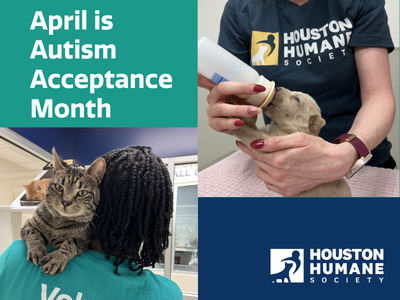
The Comfort of Connection: How Animals Support Individuals with Autism
For our Executive Director, Mary Beck, the journey of motherhood has always been rooted in love, learning, and a deep desire to understand her son.
“My son is 18 years old now, a senior in high school,” she shares. “But from a very young age, I noticed how unsettled he was. He cried often, and even small things could feel overwhelming for him. At the time, I didn’t know what it meant, I just wanted to comfort him in any way I could.”
Her son wasn’t diagnosed with autism until he was around 10 years old. Before that, Mary was navigating unfamiliar territory, searching for ways to support him without fully understanding the “why” behind his experiences.
But one thing was always clear.
“He loved animals, completely and naturally,” she says. “He talked about them all the time. His favorite toys were animals, his room was decorated with them, and when we’d go to the zoo, he didn’t just look at the animals, he wanted to be like them. It was constant, and it was something really special.”
That early connection would later become something even more meaningful.
Over time, Mary began to notice the calming effect animals had on her son.
“They ground him in a way nothing else does,” she explains. “His whole demeanor softens. His voice gets quieter, calmer. Even when he’s just talking about animals, he lights up! He laughs, he shares videos, and he wants to connect.”
There’s a mutual exchange happening, one that doesn’t rely on words.
“My son can be very cynical or irritable at times, but with animals, he’s happy. He says they’re soft, that they just sit with you. And I think it’s their response to him, too. No matter what, they want to be around him. It’s like they give each other something I can’t always explain… almost like a symbiotic relationship.”
Beyond emotional comfort, animals have also helped create structure and routine.
“Caring for animals naturally builds responsibility,” Mary says. “Feeding them, cleaning up after them– those daily tasks helped create consistency. And at the same time, it kept him close to the animals, strengthening that bond.”
That bond has become a meaningful part of their daily life.
“He doesn’t want to leave home for college, he wants to stay with his dogs because they help him relax,” she shares. “Every morning, he has a routine where he picks up one of the dogs and walks around the house. Then we do ‘family hugs’ with the dogs.”
She smiles.
“He’s 18, so he’s not big on hugs anymore, but he’ll come over with one of the dogs and say it’s time for a family hug. Then he’ll go get the other one and do it again. It’s brought us closer in ways I didn’t expect.”
Mary has also witnessed the impact of the human-animal bond beyond her own home.
“The first time I really saw it wasn’t even with my son,” she recalls. “There was a young man with autism in a crowded space, becoming overstimulated. He had a support dog. The dog stood up, placed its paws on his shoulders, and you could physically see him relax. Then the dog relaxed, too, and calmly returned to his side. It was incredible. The dog had purpose, and the connection between them was so clear.”
Moments like that reinforce something powerful: animals are more than companions, they can be partners in emotional support and regulation.
“I think as a society, as we continue to embrace neurodivergent individuals, we also have to make sure they have the tools they need,” Mary says. “Animals can be one of those tools. They help the person cope, but they also give the animal purpose. It’s a bond that benefits both.”
That belief is deeply connected to the mission at Houston Humane Society.
“I see so much opportunity for organizations like ours to create more access to these connections,” she explains. “Whether it’s volunteer opportunities, visits to schools, or simply creating space for interaction– those moments can open doors. Sometimes, as parents, we focus so much on medical or technical solutions that we can overlook something simpler… and softer.”
For families who haven’t explored animal interaction yet, her advice is encouraging and honest.
“Start by visiting a place like Houston Humane Society and talk to the staff,” she says. “Look for an animal with a calm but playful personality. One that enjoys closeness. Because if your child connects with them, they’re going to want that closeness often.”
And the impact?
“It can be amazing. Truly.”
For Mary, this journey has shaped not only her perspective as a parent, but also as a leader in animal welfare.
“I grew up with animals, so I understood what they meant to me,” she says. “But being here and seeing our mission in action has been inspiring. The human-animal bond is so much more than companionship– it’s connection, it’s confidence, it’s purpose… for both the person and the animal.”
Click here to find out ways that you can get involved with the life saving mission at Houston Humane.