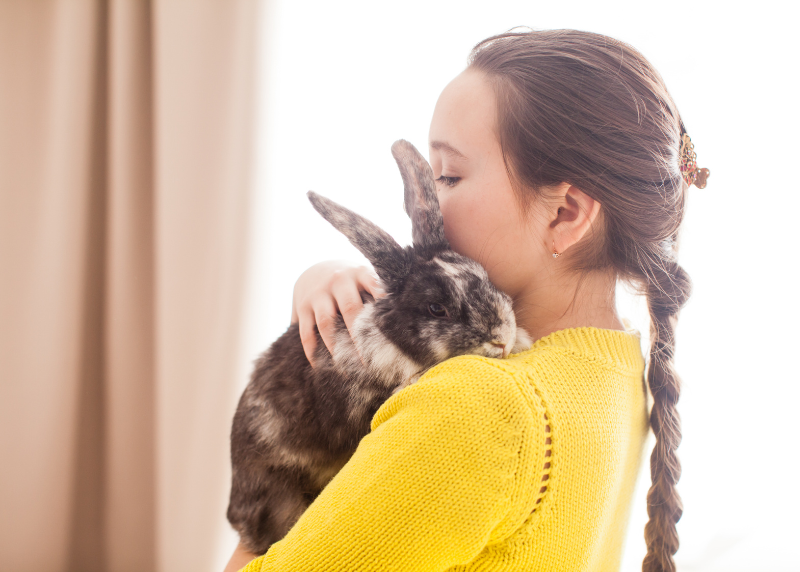
Are Rabbits Good Pets for Homes with Kids?
Rabbits can be excellent family pets, provided they’re matched with the right household and expectations. While many families ask, “Is a rabbit a good first pet for my child?”, a more accurate question is:
“Is a rabbit a good fit for our lifestyle, and are the adults in the home prepared to take primary responsibility for their care?”
Even when a rabbit is adopted as a companion for a child, daily care typically falls to the adults. That long-term commitment matters, especially because rabbits often live 8–10 years (and sometimes longer).
Common reasons rabbits are surrendered:
Most rabbit surrenders occur when families are unprepared for the time, space, and routine rabbits require. Some of the most common scenarios include:
- Easter Gifts: Year after year, shelters see an influx of rabbit surrenders that started out as “Easter gifts” for children. Impulse purchases that lead to heartbreak when the holiday is over. Living creatures do not make suitable gifts around the holidays. Bringing home a new pet is a decision that should be made with proper research, and include everyone in the household.
- Impulse Purchases/Loss of Interest: A rabbit is purchased or adopted, care is manageable for several months, and then the child’s interest decreases. The rabbit’s daily needs shift to the adults, who may not have planned for a long-term commitment.
- Accidental Litters: Two rabbits are purchased or adopted and incorrectly sexed, or housed together before spay/neuter. This can result in unexpected babies and a rapidly growing number of animals, which becomes overwhelming for many households.
- Inadequate Housing or Preparation: Rabbits are frequently marketed with small commercial cages that do not meet their needs. When rabbits lack adequate space, enrichment, and routine, they begin showing signs of stress, such as bar biting, withdrawing, guarding their enclosure, or defensive behavior. These are often interpreted as “behavior problems,” but they are commonly indicators that the rabbit’s environment needs improvement.
- Housing/Landlord Restrictions: Many rabbits are surrendered when owners move to housing that does not allow pets or has strict animal policies. Sudden relocations for school, work, or financial reasons can make it difficult to keep them.
- Unexpected Costs: Rabbits require specialized veterinary care through an exotic vet, which can be more expensive than many owners anticipate. Costs for spay/neuter surgery, dental issues, and emergency treatment often lead to financial strain.
- Allergies/Health Changes: Hay and rabbit fur are two very common allergens. Allergies to hay or fur can develop over time, making daily care difficult. Changes in a family member’s health may also limit the ability to properly care for a rabbit.
- Life Changes: Major life transitions such as divorce, a new baby, job loss, or relocation can disrupt pet ownership. During periods of instability, some families feel unable to continue caring for their rabbit.
What types of households tend to do well with rabbits?
Rabbits thrive in homes that can provide consistency, appropriate housing, and calm interaction. They are often a good match for:
- Families with children who can be calm and gentle: Many rabbits do not enjoy being picked up and can be easily startled by loud noise or quick handling. For this reason, rabbits are often most successful with children around 10 years and older.
- Households seeking a quieter companion animal: Rabbits can be social and engaging, but their affection often looks different than a dog or cat. Many prefer being approached on their terms and interacting at ground level.
- Adults who are fully committed to rabbit care: Successful rabbit ownership depends on at least one adult being prepared to manage daily care (feeding, cleaning, exercise time, and health monitoring), along with routine veterinary care and long-term planning.
A rabbit may be a great fit for your lifestyle if:
- An adult is prepared to be the primary caregiver, including taking the rabbit to annual vet visits
- Your household can provide daily routine, appropriate space, and enrichment
- Your child can follow gentle handling guidelines and respect boundaries
- You are comfortable with a pet that may not enjoy being held
A rabbit may not be the best match if:
- You want a pet your child can care for independently
- Your home environment is very loud, fast-paced, or unpredictable
- You are specifically looking for a highly handleable, consistently “cuddly” pet
- You only have space for a commercial-sized cage and are unable to offer daily exercise
Are rabbits good pets for people with allergies?
Allergies are an important consideration for many families. Some people are sensitive to hay dust or specific hay types, while others may have seasonal allergies that are worsened by storing hay indoors. If allergies are a concern, it does not automatically rule out rabbit ownership, but it does mean planning ahead.
Many households manage allergens by:
- Trying different hay varieties (some individuals tolerate orchard grass or oat hay better than timothy, for example)
- Choosing low-dust hay when available
- Storing hay in a sealed container and feeding from a rack to reduce loose dust
- Using an air purifier in the rabbit’s primary living space
If anyone in the home has a history of moderate to severe allergies or asthma, we recommend discussing rabbit and hay exposure with your healthcare provider before adopting.
Bottom line: Rabbits can be wonderful family companions when the household is prepared for their care needs and understands what rabbit behavior and bonding realistically look like.
Download our Rabbit Care 101 info booklet.